

Can Foreigners Buy Property in Bali?
Yes — foreigners can legally buy property in Bali. The two main routes are leasehold (Hak Sewa), where you hold a 25–30 year title in your own name, and freehold-equivalent ownership via a PT PMA foreign-owned company. Direct freehold title (Hak Milik) is restricted to Indonesian citizens, but the structures available to foreign buyers are well-established, legally sound, and widely used by international investors across the island.
This guide covers everything you need to know — the legal structures, the costs, the due diligence process, and the best areas to consider for your purchase.
Table of Contents
- Can Foreigners Legally Buy Property in Bali?
- Leasehold (Hak Sewa) — The Most Common Route
- Freehold via PT PMA — For Long-Term Ownership
- What to Avoid — Nominee Arrangements
- Zoning — What You Can Build and Where
- Due Diligence Before Buying
- Costs of Buying Property in Bali
- Best Areas to Buy Property in Bali
- Frequently Asked Questions
Can Foreigners Legally Buy Property in Bali?
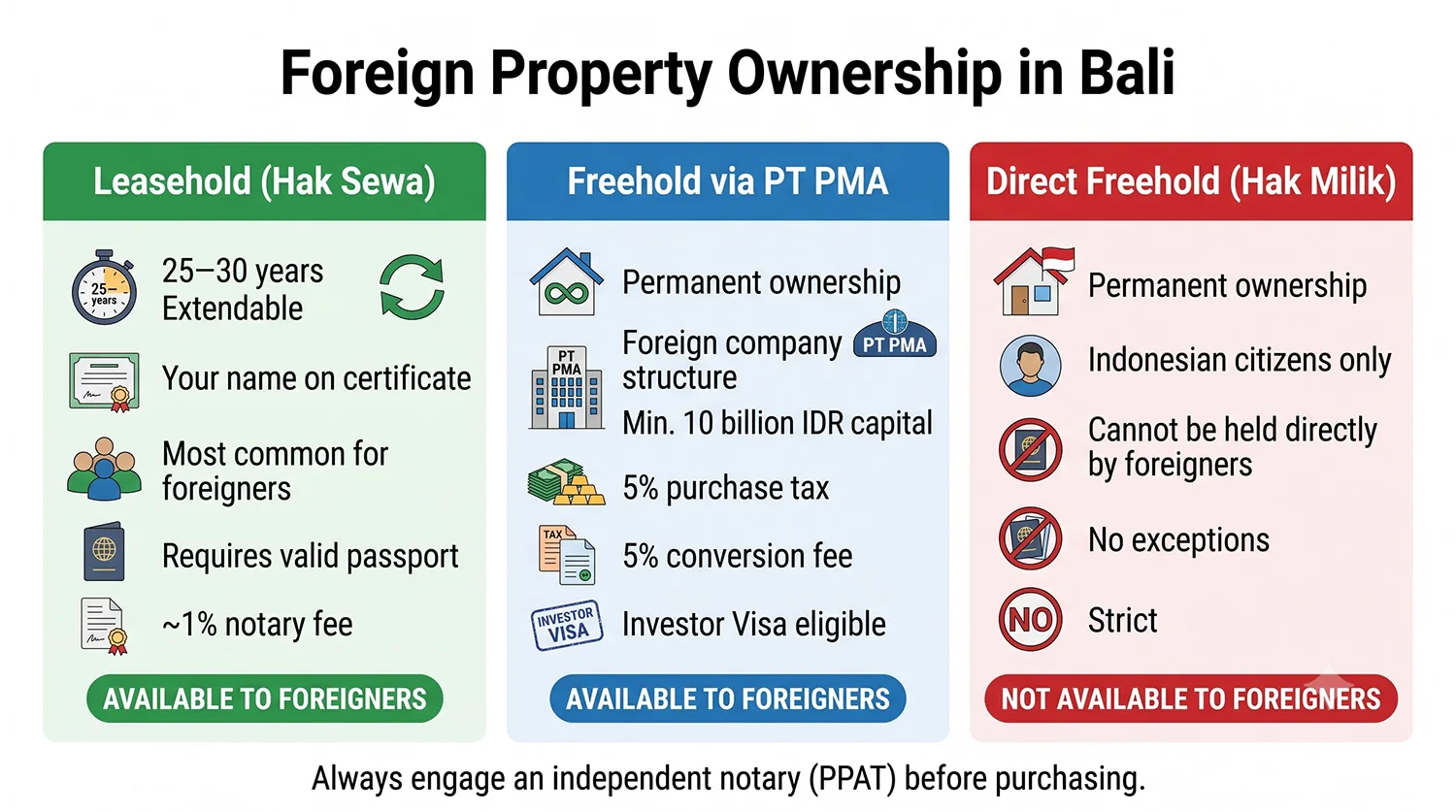
Yes — but with an important distinction. Indonesia’s property law (Law No. 5/1960 on Agrarian Principles) reserves direct freehold ownership (Hak Milik) for Indonesian citizens only. Foreign nationals cannot hold Hak Milik in their own name.
What foreign buyers can do, legally and with full title security, is:
- Hold a leasehold title (Hak Sewa) directly in their own name for 25–30 years, with extension rights
- Establish a PT PMA (foreign-owned company) to hold property under HGB (Hak Guna Bangunan — Right to Build) title, which gives freehold-equivalent control
Both structures are legal, recognised by Indonesian law, and routinely used by thousands of international buyers across Bali every year. The key is choosing the right structure for your goals and executing it through a qualified, independent notary.
Leasehold (Hak Sewa) — The Most Common Route
Leasehold is the entry point for most foreign buyers in Bali. Here is how it works:
- Lease term: typically 25–30 years, with an option to extend for a further 25–30 years written into the original agreement
- Title: your name appears directly on the lease certificate — this is not a verbal agreement or a handshake deal, it is a legally registered document
- Rights: full right to use, rent, and manage the property for the duration of the lease. You can also sell the remaining lease term to another buyer
- Requirement: a valid passport with at least 6 months remaining before expiry
- Cost: approximately 1% notary fee on the transaction value, covering legal due diligence and the registration process
For most investment-focused buyers, leasehold works well. The yield arithmetic across a 25–30 year hold period is strong, and the entry cost is significantly lower than freehold-equivalent structures. The majority of Canggu villas for sale and villas for sale in Seminyak are transacted on leasehold terms.
Freehold via PT PMA — For Long-Term Ownership
For buyers who want permanent, freehold-equivalent ownership, establishing a PT PMA (Penanaman Modal Asing — foreign-owned company) is the legal route. The company holds the property under HGB (Hak Guna Bangunan) title, which gives the same practical rights as freehold ownership.
What PT PMA setup involves:
- At least two shareholders required (can be two foreigners, or a foreigner and an Indonesian)
- Company bank account with a minimum capital of 10 billion IDR
- 5% purchase tax on the transaction value
- 5% fee to convert the certificate from Hak Milik to HGB
- 1% notary fee including due diligence
The additional benefit: PT PMA holders are eligible to apply for an Investor Visa (KITAS), valid for 2 years and extendable every 2 years. For buyers planning to spend significant time in Bali, this is a meaningful practical advantage.
PT PMA is the structure of choice for buyers at the higher end of the market — particularly those purchasing rare freehold stock in established areas like Seminyak, or large land parcels in growth corridors. See our full range of freehold villas for sale for current available stock.
What to Avoid — Nominee Arrangements
A nominee arrangement involves using an Indonesian citizen’s name on the title while privately agreeing they hold the property on your behalf. This was historically common but carries serious legal risk.
Under Indonesian law, nominee arrangements for property ownership are not legally recognised and are increasingly scrutinised. If the nominee passes away, divorces, or faces financial difficulties, your ownership claim has no legal standing. Indonesian courts have ruled against foreign buyers in disputes arising from nominee structures.
The leasehold and PT PMA routes described above are the legally sound alternatives. There is no legitimate reason to use a nominee structure when compliant options are available.
Zoning — What You Can Build and Where
Buying property in Bali also means understanding land zoning — it directly affects what you can build and whether you can operate a rental business on the property.
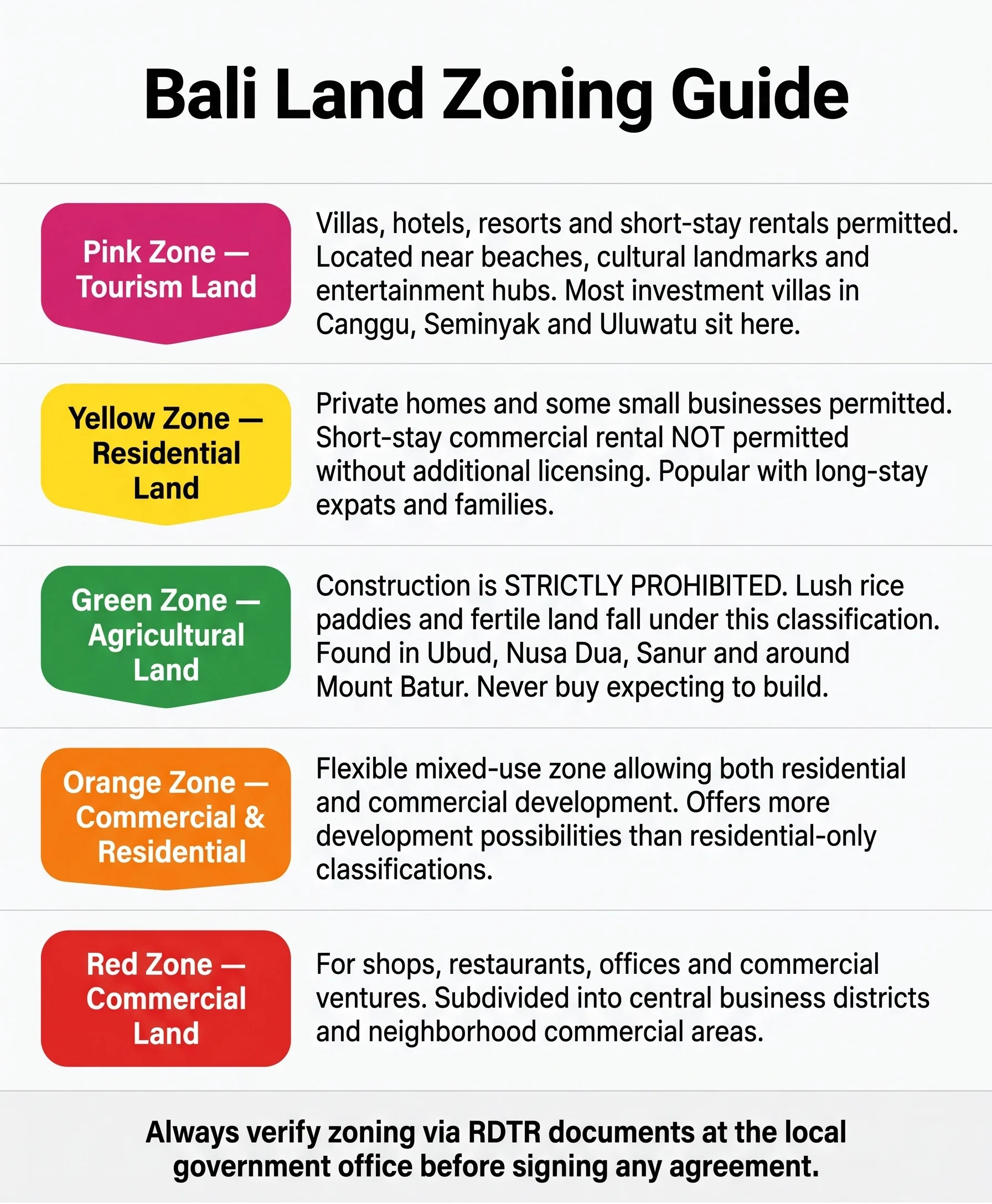
- Pink Zone (Tourism) — villas, hotels, and short-stay rentals permitted. Where most investment properties sit.
- Yellow Zone (Residential) — private homes and some small businesses. Short-stay commercial rental is not permitted without additional licensing.
- Green Zone (Agricultural) — construction is strictly prohibited. Never purchase green zone land expecting to build.
- Orange Zone (Commercial/Residential) — flexible mixed use.
- Red Zone (Commercial) — shops, offices, restaurants.
Always verify the zone classification of any land or property through the local government RDTR documents before signing anything. Your notary should conduct this check as part of standard due diligence.
Due Diligence Before Buying
Regardless of the ownership structure you choose, thorough due diligence is non-negotiable before any property purchase in Bali. Here is what to verify:
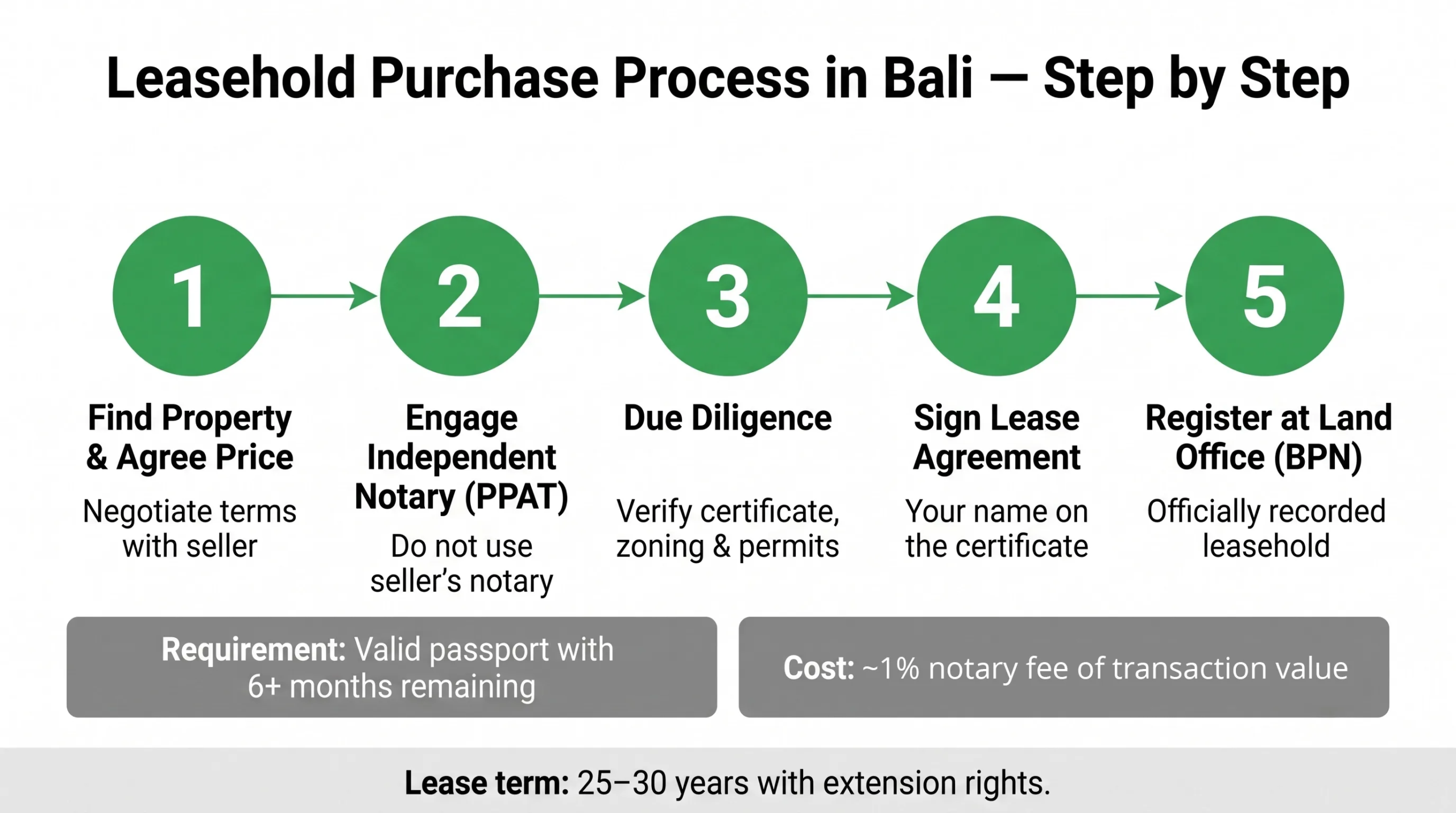
- Land certificate — verify the certificate type (Hak Milik, HGB, Hak Sewa), its authenticity at the local land office (BPN), and that the seller has the legal right to sell or lease
- Zoning status — confirm the land’s zone classification matches your intended use
- Building permits — for existing structures, verify a valid PBG (building approval) and SLF (certificate of building worthiness) are in place and match the actual building use
- Rental licensing — if you plan to operate short-stay rentals, confirm Pondok Wisata or Akomodasi Lainnya licensing is in place or obtainable
- Independent notary — always engage a PPAT notary independently, not one recommended solely by the seller or developer
- Tax clearance — verify the seller’s annual property tax (PBB) is current with no arrears
Costs of Buying Property in Bali
Beyond the purchase price, budget for these acquisition costs:
- Notary fees — approximately 1% of transaction value (leasehold and freehold)
- Purchase tax (PT PMA/freehold only) — 5% of transaction value
- Certificate conversion fee (freehold only) — 5% of transaction value
- Annual property tax (PBB) — minimal, typically a few hundred USD per year
- Seller’s income tax (PPh) — 2.5% paid by the seller, but worth factoring into negotiations
Total first-year acquisition costs typically add 7–12% above the listed price. Always factor this into your investment calculation before committing.
Best Areas to Buy Property in Bali as a Foreigner
Location determines rental demand, yield, capital appreciation potential, and lifestyle experience. The most established investment areas for foreign buyers:
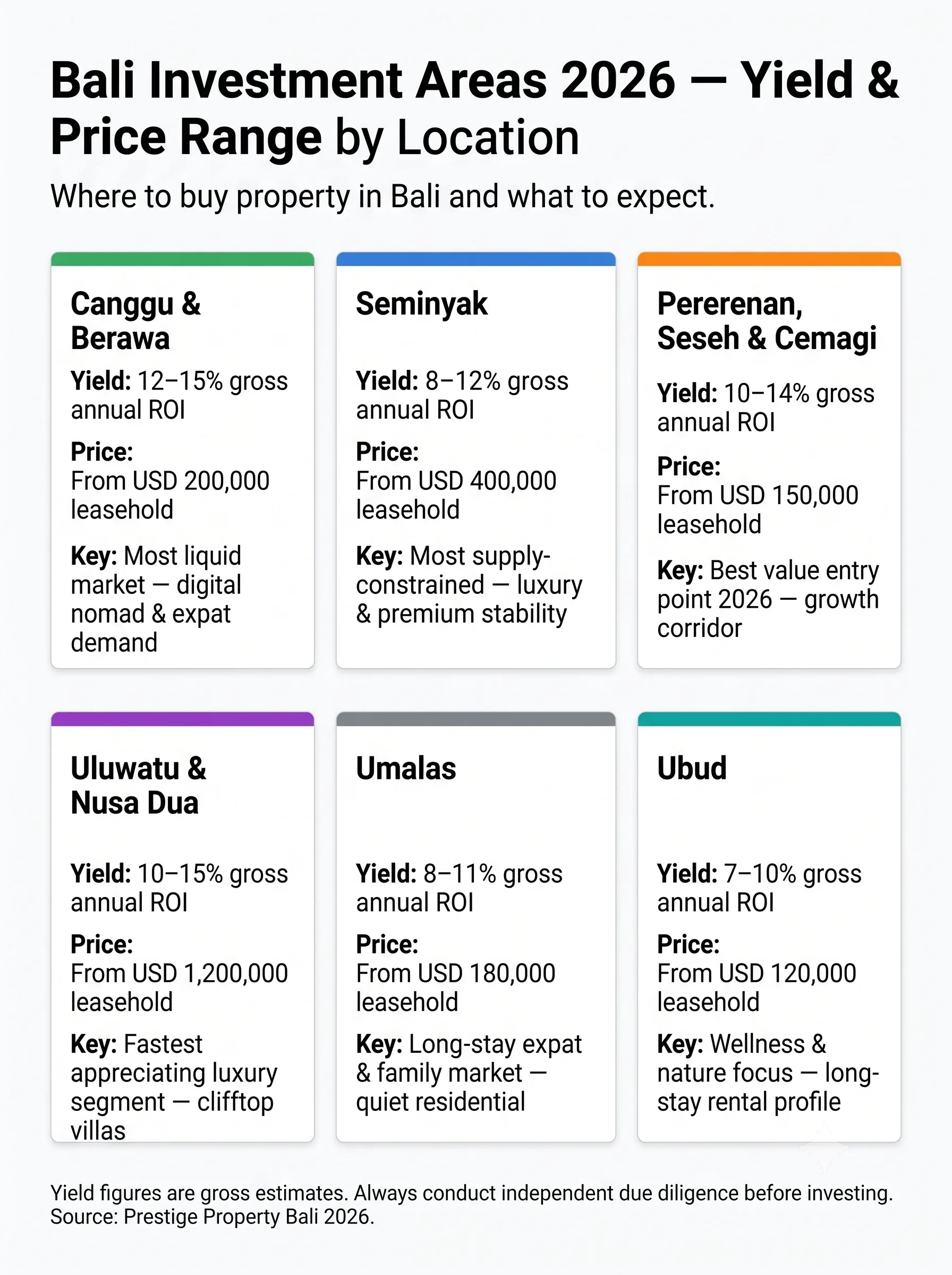
- Canggu — Bali’s most active resale market. Strong demand from digital nomads and extended-stay visitors. Yields of 12–15% for well-managed properties. The growth corridor is extending northward into Pererenan and Cemagi.
- Seminyak — Bali’s most supply-constrained luxury area. Land scarcity keeps values stable. Gross yields of 8–12% with the island’s strongest international brand recognition.
- Uluwatu & Nusa Dua — Bali’s fastest-appreciating luxury segment. Clifftop villas from USD 1.2M. Strong short-stay yields for professionally managed properties.
- Ubud — different fundamentals from the south. Lower land values, yields of 7–10%, best suited to wellness and long-stay rental profiles.
For a full breakdown of ownership structures, costs, zoning by area, and current listings, see our complete guide to Bali real estate for sale.
Ready to take the next step? Read our complete guide on how to invest in Bali property as a foreigner covering budget, legal structures, ROI and step-by-step process.
Frequently Asked Questions
Can foreigners own property in Bali outright?
Not in the same way Indonesian citizens can. Direct freehold title (Hak Milik) is restricted to Indonesian nationals under Indonesian law. Foreigners can hold leasehold title (Hak Sewa) directly in their own name for 25–30 years with extension rights, or own freehold-equivalent property through a PT PMA foreign-owned company structure.
What is the safest way for a foreigner to buy property in Bali?
The safest routes are leasehold (Hak Sewa) with your name on the certificate, or freehold via a PT PMA company. Both are legally recognised structures. Avoid nominee arrangements — where an Indonesian citizen holds the title on your behalf — as these have no legal standing and carry significant risk.
How long can a foreigner hold leasehold property in Bali?
A standard leasehold in Bali runs 25–30 years, with extension rights typically written into the original agreement for a further 25–30 years. Total effective hold period with extension: 50–60 years in most cases.
Do foreigners pay more tax when buying property in Bali?
For leasehold purchases, the primary cost is a 1% notary fee. For freehold purchases via PT PMA, buyers pay a 5% purchase tax and a 5% certificate conversion fee in addition to notary fees. Total acquisition costs for freehold transactions typically run 7–12% above the listed price.
Can a foreigner get a visa through buying property in Bali?
Yes — through the PT PMA route. Establishing a PT PMA company to hold freehold property also makes the buyer eligible for an Investor Visa (KITAS), valid for 2 years and extendable every 2 years. Leasehold purchases alone do not provide a visa pathway.