
Bali Real Estate for Sale
Bali real estate for sale offers some of the strongest investment returns in Southeast Asia — combining consistent rental demand, rising land values, and a lifestyle that attracts high-spending international buyers year-round. Whether you are looking for a leasehold villa in Canggu, a freehold estate in Seminyak, or land to build your dream property, this guide covers everything you need to know before investing.
Table of Contents
- Why Invest in Bali Real Estate?
- Types of Bali Real Estate for Sale
- Ownership Structures — What Foreigners Need to Know
- Understanding Bali’s Zoning Laws
- Investment Strategies
- Building Permits in Bali — PBG and SLF
- Prime Locations for Bali Real Estate Investment
- Due Diligence Checklist Before Buying
- Costs of Buying Property in Bali
- Frequently Asked Questions
Why Invest in Bali Real Estate?
Bali’s property market continues to deliver results that few global destinations can match. The island’s combination of timeless tourist appeal, rich culture, and relatively accessible entry prices makes it a compelling choice for both lifestyle buyers and investment-focused purchasers.
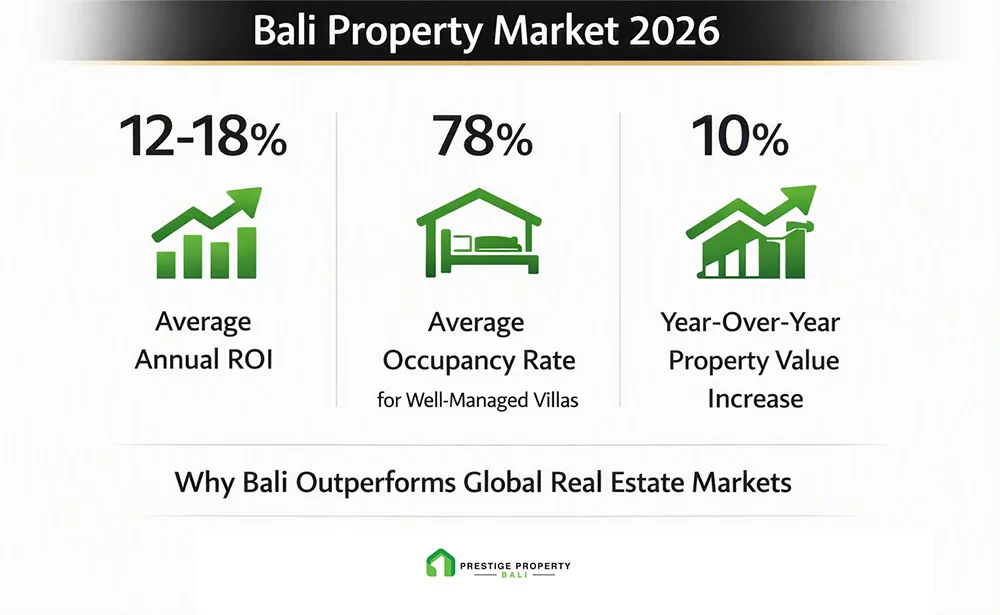
The numbers speak for themselves:
- 12–18% average annual ROI enjoyed by Prestige Property Bali clients from rental properties
- 78% average occupancy rate for well-managed villas across prime areas
- 10% year-over-year increase in property value (land and buildings) across many areas
Unlike many mature markets, Bali still offers genuine upside — rising land values in growth corridors, increasing international arrivals, and a growing remote-work demographic that sustains year-round rental demand rather than seasonal peaks.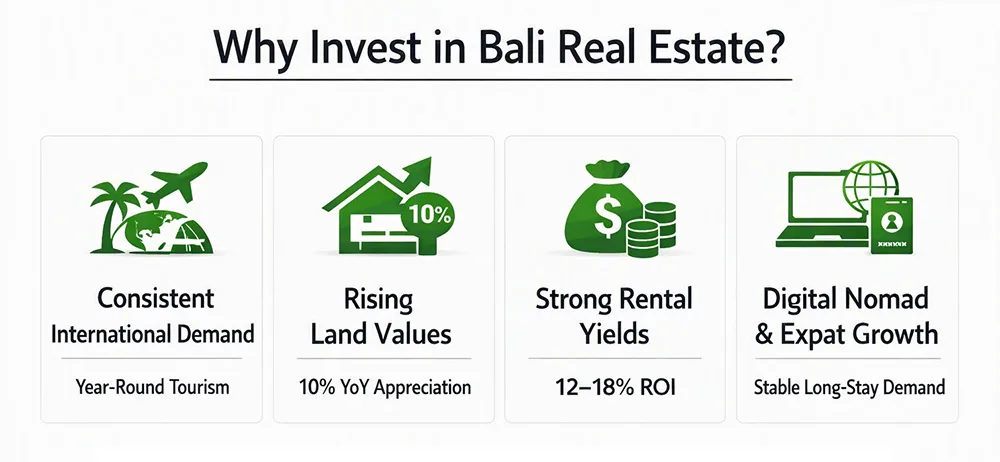
Types of Bali Real Estate for Sale
Bali’s property market offers several distinct asset types, each suited to different buyer goals and budgets:
- Villas for sale — the most sought-after asset class. Available as leasehold or freehold across all major areas. Ranges from compact 1-bedroom investment units to expansive 7-bedroom family estates. See our full selection of villas for sale in Bali.
- Land for sale — for buyers who want to build their own villa from the ground up. Significant long-term capital appreciation potential, particularly in rapidly developing corridors like Pererenan and Cemagi. Browse available land for sale in Bali.
- Off-plan developments — purchasing before construction is complete. Entry prices typically 15–25% below completed market value, with staged payment schedules during the build period. Higher risk-reward profile requiring careful developer due diligence.
- Commercial properties — hospitality, retail, and mixed-use assets in high-footfall tourism zones. Specialist category with different zoning requirements.
Ownership Structures — What Foreigners Need to Know
Understanding how foreign buyers can legally own property in Bali is the single most important step before any purchase. Two primary structures apply:
Leasehold (Hak Sewa)
Leasehold is the most common and accessible route for foreign buyers. You lease the property for a fixed term — typically 25–30 years — with your name directly on the certificate, often with an option to extend. This structure allows for a lower initial investment and delivers strong ROI because the entry cost is significantly below freehold equivalents.
Requirements: A valid passport with at least 6 months remaining before expiry is the only personal requirement.
Costs: The primary additional cost is a 1% notary fee, which covers legal due diligence and the contract process.
Freehold (Hak Milik)
In Indonesia, a Freehold Title (Hak Milik) can only be held by Indonesian citizens. For foreign investors, the legal structure to access freehold property is by establishing a PT PMA (Penanaman Modal Asing — foreign-owned company), which requires at least two shareholders.
For a complete breakdown of all legal routes available to foreign buyers, see our dedicated guide: Can foreigners buy property in Bali?
With a PT PMA, here’s what to expect:
- Company setup: open a company bank account with a minimum capital of 10 billion IDR
- 5% purchase tax
- 5% fee to convert the certificate from Hak Milik to HGB (Hak Guna Bangunan — Right to Build)
- 1% notary fee including due diligence
- Additional benefit: PT PMA holders can apply for an Investor Visa, valid for 2 years and extendable every 2 years
For a full comparison of leasehold vs freehold in Bali, see our guide on leasehold villas for sale and freehold villas for sale.
Understanding Bali’s Zoning Laws
Zoning laws in Bali determine what type of property you can build and how you can use the land. Every buyer must verify zoning status before purchasing — it directly affects what you can build, whether you can operate a rental business, and the long-term value of your investment.
- Pink Zone (Tourism Land) — ideal for tourism-driven investments: hotels, resorts, villas, and short-stay rentals. Located near beaches, cultural landmarks, and entertainment hubs. Most premium investment villas in Canggu, Seminyak, and Uluwatu sit in pink zones.
- Orange Zone (Commercial & Residential) — a flexible zone permitting a mix of residential and commercial use. Offers more development possibilities than residential-only classifications.
- Red Zone (Commercial) — for shops, restaurants, offices, and commercial ventures. Subdivided into central business districts and neighborhood commercial areas.
- Yellow Zone (Residential) — for private residences. In some cases, small businesses may be permitted depending on local regulations. Popular with long-stay expats and families.
- Green Zone (Agricultural) — construction is strictly prohibited to preserve agricultural resources. Lush rice paddies and fertile land fall under this classification. Found in Ubud, Nusa Dua, Sanur, and areas around Mount Batur. Buyers must never purchase green zone land expecting to build.
Investment Strategies
Real estate investment in Bali offers several distinct paths, each with its own risk-reward profile. Understanding your goals is the starting point for choosing the right strategy.
Strategy 1 — Off-Plan Development (The Visionary)
Purchasing off-plan means buying based on design and plan, before construction is complete. Entry prices are typically 15–25% below completed market value, with staged payment schedules during the build period. The trade-off is a 12–24 month development timeline and exposure to developer risk. Prestige Property Bali partners only with reputable developers to minimize this risk for our clients.
Strategy 2 — Move-In Ready Villas (The Strategist)
The most straightforward and fastest route to rental income. You see exactly what you are buying, can verify existing rental history, and can start generating cash flow from day one. If the property has a track record, projecting ROI is significantly more reliable than off-plan estimates.
Strategy 3 — Land Acquisition and Build (The Architect)
Buying land and building your own villa offers the greatest creative control and long-term capital appreciation potential, especially in rapidly developing areas like Pererenan, Cemagi, and outer Canggu. This path requires careful planning — from location scouting and zoning verification to design, permits, and construction management. It is the most time-intensive route but can deliver the strongest returns on a per-sqm basis for buyers who execute well.
Building Permits in Bali — PBG and SLF
To build legally in Bali, two permits are required at different stages of construction:
- PBG (Persetujuan Bangunan Gedung) — the building approval issued before construction begins, replacing the old IMB. It confirms that your project complies with zoning, safety, and planning regulations. No legitimate construction should proceed without a valid PBG.
- SLF (Sertifikat Laik Fungsi) — the certificate of building worthiness, issued after construction is completed. It certifies that the building is safe, compliant, and legally habitable. Without an SLF, operating a villa commercially is not legally permissible.
Together, PBG and SLF protect your investment and are essential for operating villas, short-stay rentals, or any commercial property. Always verify both during due diligence on any existing property purchase.
Prime Locations for Bali Real Estate Investment
Location determines everything — rental demand, occupancy rate, resale value, and lifestyle experience. Here are Bali’s most established and fastest-growing investment areas:
- Canggu & Berawa — Bali’s most liquid resale market. Consistent demand from digital nomads, surfers, and expats. Strong short-stay yields averaging 12–15% for well-managed properties. The fastest-growing area for new supply.
- Seminyak — Bali’s most supply-constrained luxury corridor. Land scarcity keeps values at a consistent premium. Gross yields of 8–12% with the strongest international brand recognition of any Bali area.
- Pererenan, Seseh & Cemagi — the growth frontier north of Canggu. Land prices 20–30% below Berawa while drawing from the same rental demand pool. The smart entry point for 2026 investors.
- Uluwatu & Nusa Dua — Bali’s fastest-appreciating luxury segment. Clifftop villas start at USD 1.2M. Strong short-stay yields for professionally managed properties. Requires extra due diligence on zoning following enforcement actions in 2025.
- Umalas — established residential area popular with long-stay expats and families. Quieter than Canggu with good access to international schools.
- Ubud — operates on different fundamentals. Land values significantly below comparable coastal plots. Gross yields of 7–10% for long-stay wellness and remote-work focused properties. Best suited to buyers drawn to culture and nature over beach proximity.
Due Diligence Checklist Before Buying Bali Real Estate
Every buyer must complete thorough due diligence before any property purchase in Bali. Here is what to verify:
- Land certificate — verify the certificate type (Hak Milik, HGB, Hak Sewa), authenticity, and that the seller has legal right to sell or lease
- Zoning status — confirm the land’s zone classification and what is permitted to build or operate on it
- PBG and SLF — for existing structures, verify both permits are valid and match the actual building use
- Rental licensing — confirm Pondok Wisata (for up to 5 rooms) or Akomodasi Lainnya licensing if you plan to operate short-stay rentals
- Notary engagement — always engage an independent notary (PPAT) for the transaction, not one recommended solely by the seller
- Tax clearance — verify the seller’s PBB (land and building tax) is current with no arrears
Costs of Buying Property in Bali
Beyond the listed purchase price, buyers should budget for the following acquisition costs:
- Notary fees — approximately 1% of transaction value, covering legal due diligence and the transfer process
- Purchase tax (for PT PMA/freehold) — 5% of transaction value
- Certificate conversion fee (Hak Milik to HGB) — 5% of transaction value, applicable for freehold purchases via PT PMA
- Annual property tax (PBB) — very low in Bali, typically a few hundred USD per year for a standard villa
- Seller’s income tax (PPh) — 2.5% of transaction value, paid by the seller but worth understanding as it can affect negotiation dynamics
Total first-year acquisition costs typically range from 7–12% above the listed price depending on the ownership structure and transaction complexity. Always factor this into your investment calculation.
Frequently Asked Questions — Bali Real Estate
The answers below cover the questions our team at Prestige Property Bali receives most often from international buyers.
Can foreigners buy real estate in Bali?
Yes. Foreigners can legally acquire Bali real estate through leasehold agreements (25–30 years, extendable, with the buyer’s name directly on the certificate) or via a PT PMA (foreign-owned company) structure for freehold-equivalent control. Direct freehold ownership (Hak Milik) is restricted to Indonesian citizens under Indonesian law.
What is the average ROI on Bali real estate?
Prestige Property Bali clients achieve an average annual ROI of 12–18% from rental properties, with an average occupancy rate of 78% for well-managed villas. Returns vary by area, property type, and management quality — Canggu and Seminyak typically deliver the strongest short-stay yields.
What is the difference between leasehold and freehold in Bali?
Leasehold (Hak Sewa) gives the buyer exclusive use and rights over the property for a fixed term (typically 25–30 years, extendable), with their name on the certificate. It is the most common route for foreign buyers. Freehold (Hak Milik) is permanent ownership but is restricted to Indonesian citizens — foreigners access freehold-equivalent control through a PT PMA company structure.
What are the main costs when buying property in Bali?
Beyond the purchase price, buyers should budget for notary fees (approximately 1%), purchase tax (5% for PT PMA/freehold transactions), and legal due diligence costs. Total acquisition costs typically add 7–12% above the listed price in the first year.
Which area of Bali is best for property investment in 2026?
Canggu and Berawa offer the strongest short-stay rental demand and liquidity. Seminyak delivers consistent premium yields in Bali’s most supply-constrained market. Pererenan and Cemagi offer the best value entry point in the growth corridor north of Canggu. The right area depends on your investment goals, budget, and preferred lifestyle.
Ready to invest in Bali real estate? Contact Prestige Property Bali for a free, no-obligation consultation — via WhatsApp, call, or our inquiry form. Our team will create a personalized investment plan tailored to your budget and goals.